


Residential Artificial Grass Installation in Reno transforms high desert yards into year-round green space without the water demand, fertilizer cycles, and seasonal dormancy of native Kentucky bluegrass and fescue lawns. Reno sits at 4,500 feet in the rain shadow of the Sierra Nevada, where winter snow and hard freezes lock real grass into brown dormancy for months, and July heat burns it out in weeks. The Truckee Meadows climate, alkaline clay soils, and the intense afternoon wind make living turf a constant fight. Modern synthetic turf lets homeowners in Reno, Sparks, Spanish Springs, and the surrounding valleys keep a functional, attractive yard without chasing water bills, mowing schedules, or brown patches. We have been installing artificial grass and synthetic turf in the Reno area since 2013, and we build every installation to written specifications so you know exactly what you are getting.
Why Residential Artificial Grass Installation Matters in Reno's High Desert Climate
Real lawns in Reno fail for predictable reasons. Kentucky bluegrass and fescue thrive in cool, moist climates, not in a high desert valley with single-digit winter lows, intense summer heat, and alkaline, rocky soils. Winter snow cover keeps grass dormant and brown from November through March. Spring and early summer bring wind and low humidity that stress young growth. July heat and low rainfall scorch the lawn brown by mid-summer. Fall recovery is brief before frost returns. Most Reno homeowners accept brown winters and brown summers as normal, or they spend thousands on irrigation and chemical inputs to fight the climate. Artificial turf solves this problem entirely.
- Stays green year-round without irrigation, fertilizer, or seasonal dormancy.
- Eliminates mowing, dethatching, and disease management in Reno's dry air.
- Handles heavy snow load and freeze-thaw cycles without damage or bare patches.
- Drains fast in spring snowmelt and survives the Truckee River floodplain without rot or compaction.
- Requires only occasional rinsing and brushing, never watering or chemicals.
Homeowners across Reno and Sparks choose turf because it actually works in this climate, and it frees up water for other uses during drought years.
Local reality: A real lawn in Reno's backyard typically sits brown from November through April and again from mid-July through September. Artificial grass stays green and functional every day of the year, even under 12 inches of snow or during a 100-degree July afternoon.
For more information on how artificial turf performs in Reno's climate, see our homepage or call us at (775) 993-3807 for a free estimate.
How We Install Residential Artificial Grass in Reno: The Right Way from Base to Seams
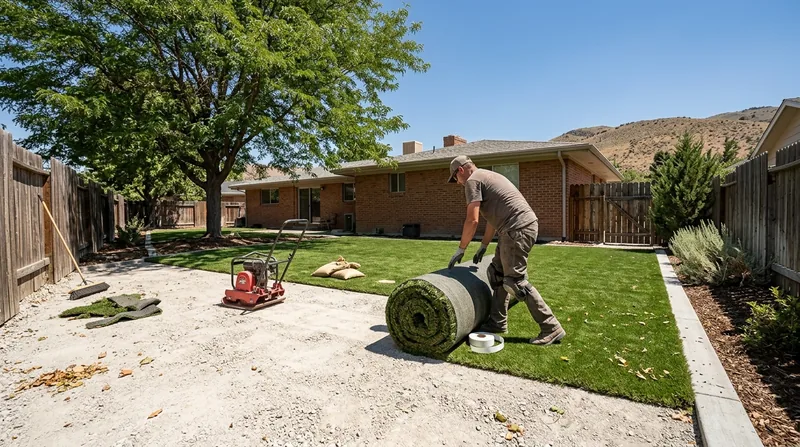
Artificial turf installation is not a weekend DIY job or a roll-out-and-staple operation. Poor base prep, undersized infill, and weak seam work are the leading causes of turf failure in Reno yards. We remove the old sod, grade and compact the subgrade, lay a compacted base of recycled asphalt or sand, install a drainage underlay, and seam the turf with adhesive and backing tape so it stays flat and functional for years. Every step matters, and we document our work in writing.
- We remove existing sod and grade the yard to proper slope for drainage away from structures.
- We compact the base layer to 95% with a plate compactor and verify density on site.
- We install a geotextile or rubber underlay to prevent weed growth and improve drainage in clay soils.
- We seam turf with polyurethane adhesive and reinforced backing tape, then brush and test every seam for pull strength.
- We top-dress with the infill type specified for your turf (silica sand, recycled rubber, or Envirofill for pet yards) and verify the depth with a gauge.
- We brush the turf against the nap, rinse it clean, and walk the yard to verify drainage and flatness before we leave.
This process takes 2 to 4 days for a typical residential yard in Reno or Sparks, depending on size and site conditions.
Example: A 1,000 sq ft backyard in Hidden Valley with old sod, compacted soil, and a slope toward the house takes 3 days: Day 1 removal and grading, Day 2 base and underlay, Day 3 turf, seams, infill, and finish. We call before we start and text photos when we are done.
If your yard has drainage issues, wet spots, or a history of standing water, we fix the drainage problem first or we will not install turf. See our turf removal and replacement page for more detail on site prep and grading.
| Approach | Description | Best for |
|---|---|---|
| Recycled asphalt base with sand topper | Compacted recycled asphalt (RAP) 4 to 6 inches, topped with 1 to 2 inches of sand, geotextile between layers | Most Reno residential yards, excellent drainage, handles freeze-thaw and snow load |
| Permeable concrete or porous paver subbase | Turf installed over permeable concrete pad or porous pavers with underlay, used when hard surface is preferred or required | Patios, pool surrounds, areas with poor drainage or clay that won't compact |
| Rubber crumb or sand infill | Recycled rubber crumb or silica sand (or blend) applied at 1.5 to 2.5 lbs per sq ft, brushed into the pile | All residential turf, weight and performance depend on pile height and face weight of the turf product |
| Envirofill or zeolite for pet turf | Antimicrobial infill (Envirofill or zeolite) applied at specified depth, designed to lock odor and drain urine quickly | Dog runs, pet yards, areas with high use and odor concerns, reinforced drainage required |
Residential Artificial Grass Installation Cost in Reno: What to Expect
The cost of artificial grass installation in Reno ranges from $8 to $15 per square foot, depending on the turf product, base depth, site conditions, and infill type. A typical 1,000 sq ft residential yard runs $8,000 to $15,000 installed. Smaller yards (400 to 600 sq ft) tend to cost more per square foot because mobilization and base prep are fixed costs. Larger yards (2,000+ sq ft) often come in at the lower end of the range. The biggest cost factors are the quality and face weight of the turf product, the depth and compaction of the base, the type of infill, and site difficulty (old sod removal, grading, slope, drainage fixes, or tree roots).
- Base turf product (15 to 20 oz face weight, standard pile height) starts at the lower end of the range.
- Premium turf (25 to 30+ oz face weight, UV-rated for Reno sun, realistic color) costs more but lasts longer and looks better.
- Site prep and base depth drive the cost up if old sod must be removed, soil amended, or drainage improved.
- Infill type affects cost: silica sand is standard, recycled rubber costs more, and antimicrobial infill for pet yards is premium.
- Tree roots, rock outcroppings, or poor drainage that requires rework can add $1 to $3 per square foot.
We always measure the yard on site and provide a written estimate with the turf product name, face weight, pile height, infill type and pounds per square foot, base depth, and total labor and material cost. We do not charge by the hour or offer per-square-foot pricing over the phone. See our pricing page for more detail and worked examples for common yard sizes in Reno.
Residential Artificial Grass Installation Near Me: What to Look for When Hiring a Turf Installer
Hiring the right turf installation company in Reno means checking three things: insurance, a written spec, and references. Many crews lay turf without a written contract or detailed product information. Some operate out of a truck and disappear after the job. A professional turf installer in Reno gives you a written estimate with the turf product name, face weight, pile height, infill type, base depth, and total cost. They carry general liability and workers compensation insurance and can provide a certificate. They have a local address, answer the phone, and will show you photos of finished work in Reno or nearby. They warranty the installation (not the turf manufacturer) for one to three years.
- Ask for a certificate of insurance naming general liability and workers compensation coverage.
- Request a written estimate that names the turf product, face weight, pile height, infill type and depth, and base depth.
- Call two or three references and ask about the quality of the seams, drainage, and how the turf has held up after one year.
- Ask whether the company handles HOA submittals if your front yard is restricted by architectural guidelines.
- Confirm that the company is local, has a phone number and address in the Reno area, and is available for follow-up maintenance or repairs.
Artificial turf is not maintenance-free, but it is low-maintenance. After installation, you rinse it occasionally, brush it to keep the pile upright, and remove debris. If you have questions after the job is done, your installer should be reachable. Contact us at (775) 993-3807 or visit our contact page to schedule a free estimate. We are fully insured, we provide a written spec for every job, and we have been installing turf in Reno since 2013.
Residential Artificial Grass Installation in Reno: Pricing Guide
| Service | Price | Details |
|---|---|---|
| Standard residential yard (400-600 sq ft) | Starting at $8/sq ft | Includes sod removal, compacted base, standard turf, silica sand infill, and seaming |
| Typical residential yard (1,000 sq ft) | Starting at $8-12/sq ft | Base cost $8,000-12,000; increases with tree roots, poor drainage, or premium turf products |
| Large yard or complex site (2,000+ sq ft, drainage fixes, or premium turf) | Starting at $10-15/sq ft | Includes drainage rework, deeper base, premium face weight turf, and reinforced seaming for durability |
| Pet turf or antimicrobial infill | Starting at $11-15/sq ft | Adds cost of Envirofill or zeolite infill, reinforced drainage underlay, and specialized installation technique |
| Estimate and site visit | Free | Response within 24 hours, no obligation to book, detailed written estimate with all specifications included |
Indicative pricing, the exact cost depends on square footage, finish, and site access. Free personalized estimate within 24h at (775) 993-3807.


